WHAT IS BIO - HETHAN?
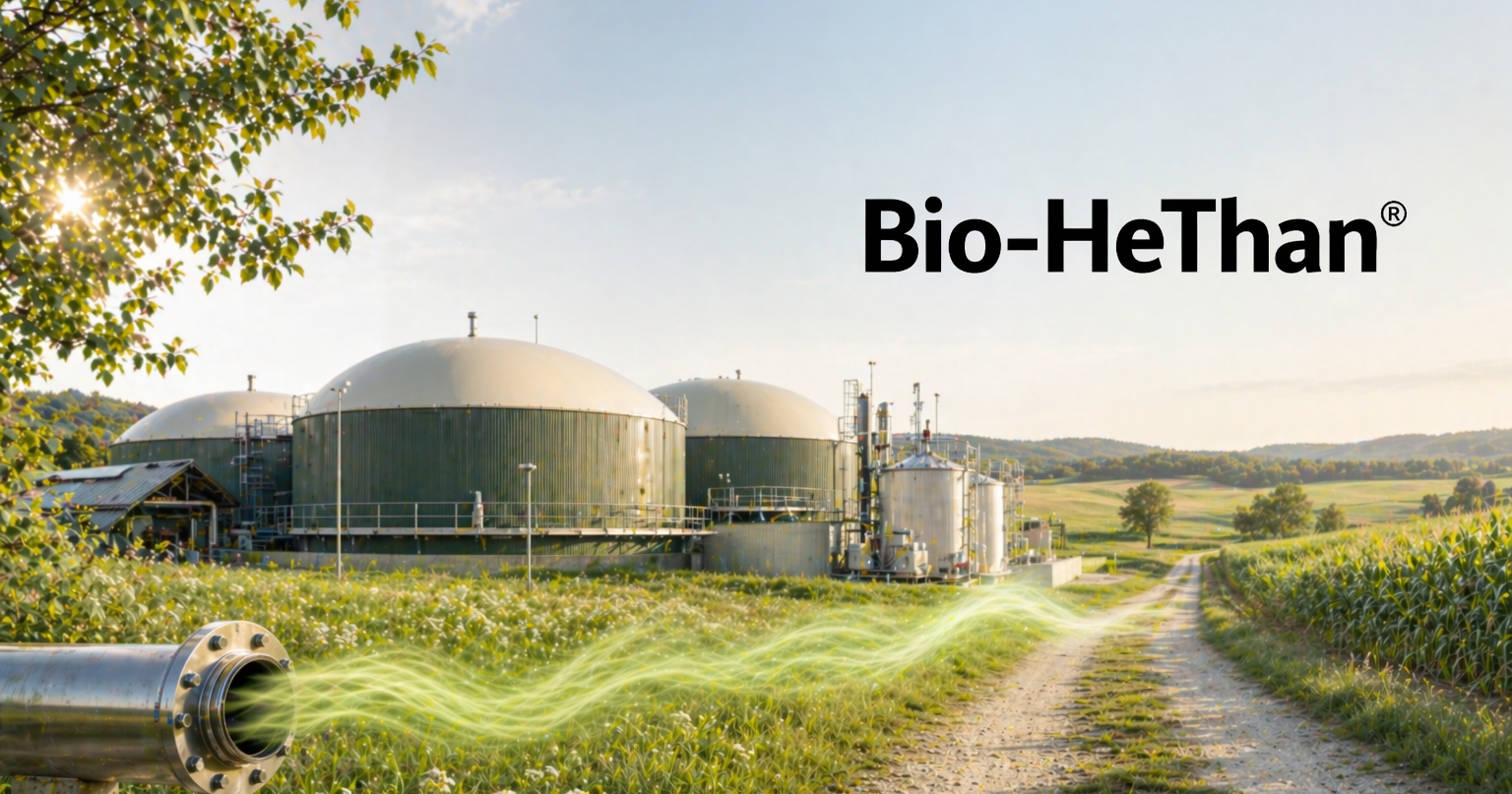
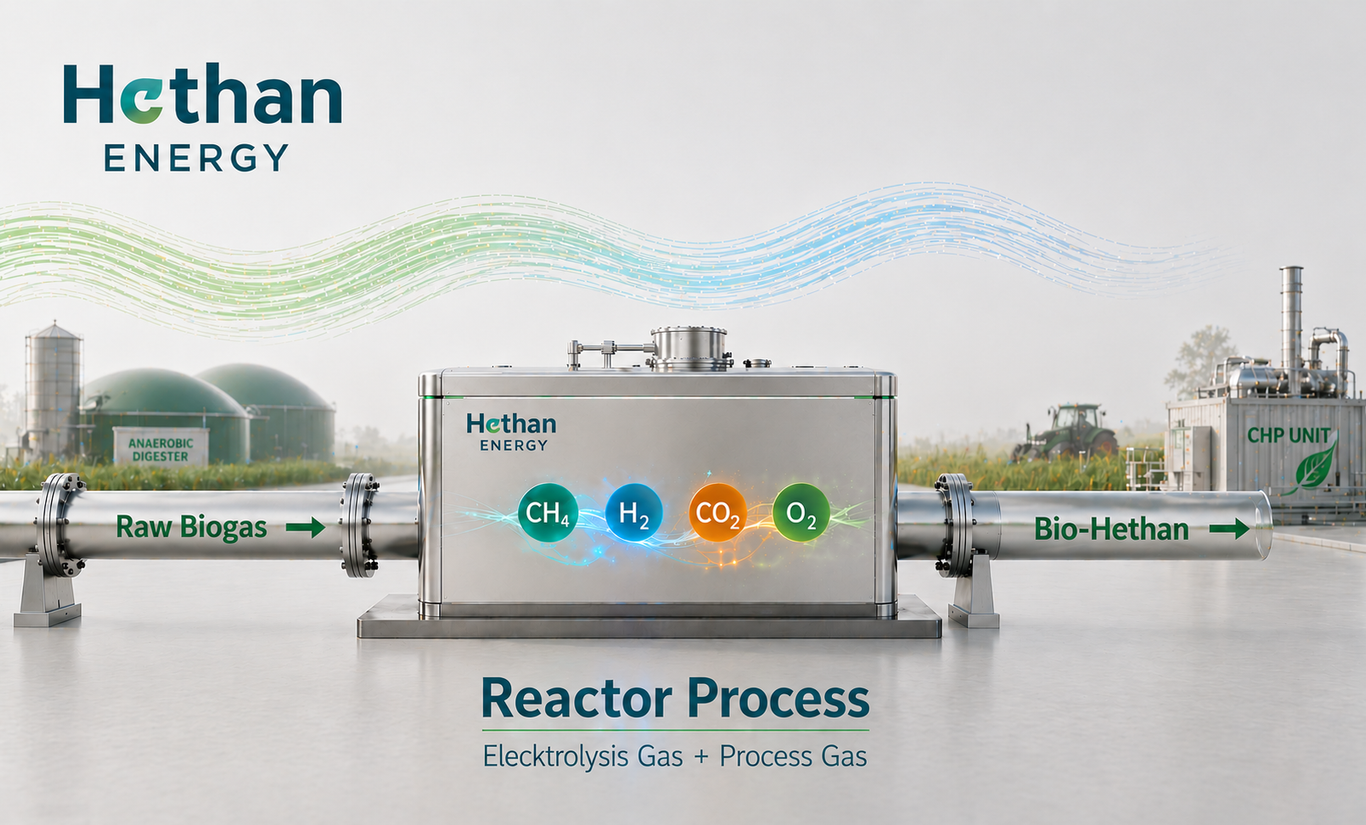
By feeding raw biogas directly into our Hethan system, Bio-Hethan is produced—a hybrid gas containing electrolytic hydrogen and oxygen as well as methane (CH₄) and carbon dioxide (CO₂) from the raw biogas.
While the CO₂ content reduces the calorific value compared with Hethan Classic, it enhances operational safety by making the gas mixture less readily ignitable—an advantage for certain applications. At the same time, the CO₂ contained in the raw biogas is put to productive use rather than being removed through energy-intensive upgrading processes, making Bio-Hethan an especially efficient and sustainable energy solution.
RAW BIOGAS UPGRADING
Bio-Hethan is a versatile hybrid gas that eliminates the need for costly upgrading of raw biogas to biomethane. Farms and agricultural cooperatives can use Bio-Hethan to establish fully decentralized energy cycles directly linking digesters, CHP plants, and even agricultural machinery.
Bio-Hethan reduces dependence on fossil gas sources, incurs no fossil CO₂ costs, and maximizes the value of available biomass resources. The result is a truly regional circular economy wherever crop residues, agricultural waste, manure, and other organic feedstocks are available.
BENEFITS AND APPLICATINS OF BIO-HETHAN
NO EXPENSIVE BIOGAS PURIFICATION
Raw biogas is normally upgraded to remove CO₂ and other impurities—particularly when producing biomethane for injection into the natural gas grid. The Hethan technology eliminates the need for these costly processing steps. Instead, it utilizes desulfurized raw biogas directly and intentionally retains the CO₂ within the gas mixture. This avoids expensive upgrading processes such as CO₂ removal, drying, and siloxane filtration, while enhancing operational safety and enabling direct enrichment with electrolytic gases. The result is Bio-Hethan—a versatile hybrid gas that can be produced locally and used in existing CHP plants and agricultural machinery. By leveraging locally available biomass resources, Bio-Hethan helps farms and agricultural cooperatives reduce dependence on fossil gas sources and avoid fossil CO₂ costs, creating a more sustainable and decentralized energy system.
REGULATORY CLASSIFICATION
Bio-Hethan is generally classified as a renewable gas, as it is produced entirely from biogenic sources and contains no fossil CO₂. Because it is used locally and is not injected into the natural gas grid, upgrading to biomethane is not required. Enrichment with electrolytic gases enhances combustion performance, reduces raw biogas consumption, and can increase engine output by up to 20% or more, depending on the Bio-Hethan composition. In addition, no fossil CO₂ costs are incurred. For agricultural operators, Bio-Hethan offers a high degree of independence, as its decentralized use can reduce reliance on grid-related requirements and regulatory frameworks. While additional funding programs may be available, the ability to operate without dependence on subsidies provides a stable, flexible, and economically attractive perspective for existing biogas plants.
OPERATION MODEL FOR AGRICULTURE
The operating model is based on a partnership approach: agricultural operators provide raw biogas, water, and renewable electricity, while Hethan Energy supplies, operates, and maintains the Hethan system on-site. Farmers incur no capital investment and assume no technical risk, as Hethan Energy retains ownership of the equipment. The resulting gas products are marketed through long-term gas supply or participation agreements, ensuring stable and market-based revenues for all parties involved. This creates a mutually beneficial model that enables farmers to maximize the value of their existing resources while participating in a sustainable and decentralized energy economy.
FURTHER APPLICATIONS
Bio-Hethan offers significantly improved combustion characteristics compared with conventional raw biogas. The gas ignites more readily, burns more completely, and delivers a higher amount of usable energy. This enhanced energy performance opens up a wider range of applications, including higher-output CHP operations, industrial process heat, drying systems, greenhouse facilities, and appropriately adapted engines. Bio-Hethan is also an attractive renewable energy carrier for Power-to-X applications, as it provides a more stable and energy-rich feedstock than raw biogas.
MICROBIAL PROTEIN PRODUCTION
Microorganisms can convert methane, hydrogen, CO₂, and oxygen into high-value protein products through fermentation. Depending on the desired protein characteristics and quality, different gas compositions may be required. Together with selected research and industry partners, Hethan Energy will investigate the extent to which Hethan gases are suitable for the production of alternative feed and food proteins. Gas fermentation-based proteins offer significant advantages: they require very little land, consume minimal amounts of water, are independent of climate conditions and conventional agriculture, and can be precisely tailored to achieve an optimal nutritional profile. As a result, they represent a scalable and sustainable source of protein—particularly important in light of a growing global population and increasing demand for high-quality protein products.
BIO-HETHAN:
KEY FACTS & FIGURES
100 %
biogenic
(contains no fossil gas)
up to 100 %
lower fossil CO₂ emissions
→ ≈ 0 kg fossil CO₂ / kWh
up to 50%
reduced raw biogas consumption through upgrading with electrolytic gases
→ stable, local and predictable costs
HETHAN OR
BIO - HETHAN?
Which solution best fits your application? Our hybrid gases offer distinct advantages depending on your specific use case and sustainability goals.
We would be happy to advise you – get in touch with us!